

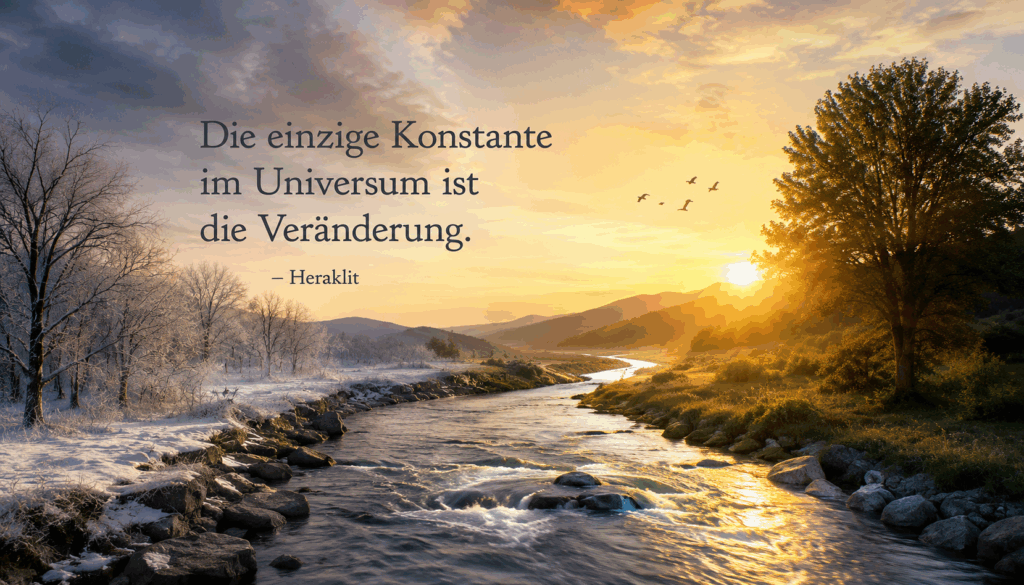
“The only constant in the universe is change.” — Heraclitus
Heraclitus formulated this about 2,500 years ago. Since then, much has changed — and yet people still struggle with exactly this same fact. Not because they don’t know better. But because knowing and experiencing are two entirely different things.
Why Change Feels So Hard — And Why That’s Completely Normal
The human brain is no friend of the unknown. It prefers the familiar, even when the familiar has long stopped working. This mechanism made evolutionary sense: whoever avoided the unfamiliar risked their life. Today, this pattern rarely costs a life — but it often costs quality of life.
Psychologically, our system reacts to change much like it reacts to threat. The prefrontal cortex, responsible for weighing options rationally, loses influence the moment uncertainty enters the picture. The result: we cling to the familiar, sabotage our own decisions, and procrastinate. Not out of weakness. Out of neurobiology.
Then there’s identity. Who am I if I no longer do what I’ve done for years? Who am I if this relationship ends, this job disappears, this life plan turns out to no longer hold up? Change cuts deep into our sense of self. That’s not dramatic — but it should be taken seriously.
Forced Change vs. Chosen Change
It makes a significant difference whether change comes from outside or from within. A layoff, a breakup, a move brought on by external circumstances — these are cuts you couldn’t prepare for. The ground disappears beneath your feet without warning.
Chosen change, on the other hand, is the opposite of easy. Because here, you carry the responsibility yourself. You made the decision — and now you have to live with the consequences. That’s often harder than it sounds. The freedom to decide also means the burden of the decision.
Both forms have one thing in common: they mark a transition. A space in between, where the old no longer applies and the new doesn’t yet hold. This in-between space is uncomfortable. But it’s also where real development begins.
What Coaching Actually Does for Change
Change coaching in Vienna — it sounds like a buzzword. But behind it is a concrete process. Coaching isn’t about giving advice or prescribing solutions. It’s about creating clarity — about your own values, your blockages, and what you truly want, beyond other people’s expectations.
One example: someone has been considering changing jobs for years. Rationally, the decision has long been made. And yet nothing happens. In coaching, it often turns out that behind the paralysis isn’t laziness, but fear — of failure, of others’ judgment, of one’s own inadequacy. Being able to name this fear is the first step toward no longer letting it steer you.
Another example: a relationship ends. The grief is real. At the same time, the question arises: What do I want now? Not what should I want — but what do I actually want. Coaching creates a space where these questions can be asked without judgment.
Or: a career reorientation after turning fifty. Often met with a smile from society, yet urgently needed on the inside. Here, coaching helps recalibrate your own compass — without following other people’s expectations.
Anyone seeking professional support for deep psychological strain caused by change can also find further information from the Austrian Society for Child and Adolescent Psychiatry, Psychosomatics and Psychotherapy — as an additional resource alongside coaching.
For more on the concrete content and process of a coaching journey, see Life Coaching in Vienna.
For a detailed overview of how a coaching process generally unfolds and when it’s the right approach, see the article How Coaching Can Help — And When It’s the Right Tool.
When Change Turns Into Conflict — The Role of Mediation
Not every change is an internal process. Sometimes friction arises between people: in companies, when structures shift and roles become unclear. In families, when an inheritance needs to be settled or life paths grow apart. In partnerships, when one person wants to grow and the other experiences that as a threat.
Mediation is not an arbitration tribunal. It’s a structured process in which everyone involved gets to speak — without anyone having to win or lose. The goal isn’t agreement at any cost, but a workable solution for everyone.
In change-related conflicts, mediation helps especially when the substantive question (What should change?) has long been overshadowed by hurt feelings, misunderstandings, and entrenched positions. What’s needed here is someone who holds the frame — not someone who judges, but someone who structures.
Accepting Change — Not Forcing It
Heraclitus was right. But acceptance is not a passive act. It means actively swimming with the current — not against it, but not blindly with it either. Change doesn’t succeed through willpower alone, but through awareness, support, and courage.
If you’re currently in the middle of such a transition — professionally, personally, or in a relationship — and notice that you can’t move forward alone: that’s not a sign of weakness. It’s the moment to reach out for support.
Frequently Asked Questions
Why does change feel so hard for most people?
Because the brain favors the familiar and processes change much like a threat: the prefrontal cortex loses influence the moment uncertainty enters the picture. This is an evolutionarily conditioned mechanism — not a personal failure.
What’s the difference between forced and chosen change?
Forced change happens without your own doing, for example through a job loss. Chosen change is brought about deliberately and comes with the freedom — and burden — of your own decision. Both mark a transition in which the old no longer applies and the new doesn’t yet hold.
How can coaching concretely help with change processes?
Coaching creates clarity about your own values, blockages, and what you truly want — beyond other people’s expectations. It doesn’t offer ready-made solutions, but a space where these questions can be asked without judgment.
When does professional support make sense during a change?
When change leads to conflict — for example in family, work, or a relationship — or when you remain stuck despite having rational clarity. In both cases, coaching or, for interpersonal conflicts, mediation can help.