

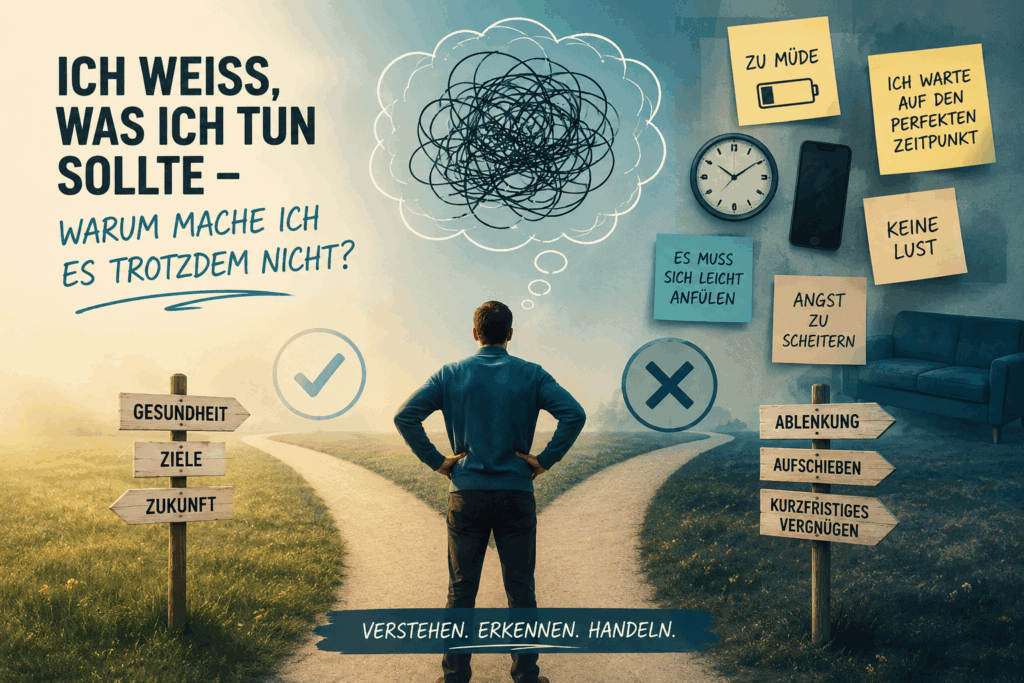
The Knowledge-Behaviour Gap in Coaching
The so-called knowledge-behaviour gap describes a familiar pattern: exercise more, go to bed earlier, finally have that difficult conversation — the intention is often clear, well-reasoned, and sincerely meant. And yet so much stays exactly where it always was. Anyone who notices this in themselves is neither weak-willed nor the exception. Psychology has studied this pattern closely for decades — and has a clear answer for what actually helps.
The Knowledge-Behaviour Gap Is the Norm
In behavioural psychology, this phenomenon has its own name: the intention-behaviour gap. It refers to the distance between what someone plans to do and what actually happens. Several review studies arrive at a remarkably consistent finding: on average, a person’s own intention explains only about 18 to 23 percent of whether a behaviour actually follows (Sheeran & Webb, 2022).
It becomes even clearer when you look only at people who have firmly decided to change something: between 42 and 54 percent of them fail to follow through on their intention. At the same time, only 2 to 3 percent of people without a corresponding intention act anyway. A firm resolution does make a difference — just a much smaller one than it feels like when you make it.
Why a Good Intention Alone So Often Isn’t Enough
This isn’t a question of discipline in the moral sense — it can be explained by a number of well-studied factors.
Not Every Intention Is Equally Strong
Research on the intention-behaviour gap shows that an intention’s stability is, above all, what matters. Intentions that stay consistent over time correlate far more closely with actual behaviour than intentions that shift from day to day. How certain someone feels about an intention matters too: people who are sure of their decision are more likely to follow through than those who are still weighing it up (Sheeran & Webb, 2022).
The Moment of Action Is Underspecified
“I want to exercise more” is an intention without a concrete trigger. It leaves open the question of exactly when, exactly where, and what to do if something gets in the way. Without that specification, whether the intention turns into behaviour is left to whatever the day happens to bring — and everyday life rarely has time to spare.
Existing Habits Compete With the New Intention
Most of our everyday behaviour runs on autopilot, without conscious decision-making. A new intention doesn’t arrive on an empty field — it meets established patterns that get triggered in the very same situations. As long as those old patterns aren’t replaced by something new, they win almost every everyday moment by default.
What Actually Helps, According to Research
The best-researched lever for narrowing this gap is what’s known as implementation intentions — a concept developed largely by psychologist Peter Gollwitzer. The core idea: instead of stating a general intention, you decide in advance exactly which behaviour follows in which situation — for example: “When I get home in the evening, I put on my running shoes before I sit down.”
A widely cited meta-analysis by Gollwitzer and Sheeran, covering 94 studies, shows a medium-to-large effect on actual goal attainment (d = .65). Implementation intentions were especially helpful for getting started in the first place (d = .61), and even more so for not giving up entirely after a setback (d = .77) (Gollwitzer & Sheeran, 2006).
Two mechanisms explain why this works. First, the critical situation gets marked so clearly in your mind that it’s easier to notice in everyday life — you essentially “stumble” onto your own trigger. Second, the planned response becomes so tightly linked to the situation that, over time, it plays out almost automatically, without needing fresh willpower in every single moment.
Why Patience Itself Is Part of the Change
A second reason change feels like such an uphill battle has to do with how long a new behaviour takes to become established. In a widely cited study, researchers had participants repeat a new health-related behaviour daily for several months and measured how automatic it felt at each point. On average, it took 66 days before a new behaviour felt noticeably automatic — though the range, depending on the person and the behaviour, spanned from 18 to more than 250 days (Lally et al., 2010).
That explains a common source of frustration: many people abandon a new habit exactly during the phase when it still feels effortful but is just about to get easier. Knowing that several weeks of visible effort are normal makes it far less likely that a rocky start gets read as personal failure.
Coaching Perspective: Behaviour, Not Blame
This gap shows up very often in coaching — not as a sign of missing willpower, but as the logical consequence of how behaviour actually forms. People generally act on the best option available to them in a given moment. Anyone who’s quick to diagnose themselves with “no discipline” usually overlooks the real task: making the intention concrete enough that it actually stands a chance in everyday life.
This is exactly where coaching can help — not by handing over ready-made solutions, but by helping to sharpen the intention, find realistic triggers, and put setbacks in context instead of treating them as proof of failure. Insight and good will are an important starting point. But change only becomes visible where new choices actually appear in everyday life.
Reflection Questions for Everyday Life
- Which intention in my life fits this pattern right now — where do I know something but don’t act on it?
- How concrete is my intention, really? Do I know exactly when, where, and how I want to act?
- Which existing habit is currently competing with what I’m trying to do?
- What would a simple if-then plan look like for this exact intention?
- How would I notice that the new behaviour feels easier after a few weeks?
Frequently Asked Questions: The Knowledge-Behaviour Gap
Does the knowledge-behaviour gap mean I’m simply weak-willed?
No. Research shows this gap is a general psychological phenomenon that affects most people, regardless of willpower. What usually matters is not the strength of someone’s will but how concrete the intention is — and whether it competes with existing habits.
What does a good if-then plan actually look like?
An if-then plan names a clear situation (the “if”) and an equally clear response to it (the “then”) — ideally with no room for interpretation. “I’ll try to meditate more” isn’t a plan like this; “When I’ve poured my morning coffee, I’ll sit down for five minutes and breathe deliberately” is.
What if I slip back into the old pattern despite having a plan?
A single slip doesn’t automatically disprove a plan. It’s more useful to look closely at the specific situation where it broke down: was the trigger defined clearly enough? Did something unexpected get in the way? That kind of review usually lets you sharpen the plan rather than abandon it altogether.
How long does it take for a new action to become a genuine habit?
On average, around 66 days, according to a widely cited study — though the range, depending on the person and the behaviour, spans from 18 to more than 250 days (Lally et al., 2010). Knowing this means the typical rough patch doesn’t have to be read as personal failure, but as a normal part of the process.
Conclusion: The Knowledge-Behaviour Gap Closes in Small Steps
The fact that knowledge and good intentions alone don’t produce new behaviour isn’t a personal weakness — it’s a well-documented psychological pattern. What actually helps is strikingly concrete: a precise if-then statement instead of a vague intention, and the willingness to give a new behaviour several weeks before judging it. Adopting this view of change won’t make everything different overnight. But it does make it possible to put your own setbacks in a more realistic light — as part of the process, not its opposite.
For a closer look at how knowledge itself forms, and under what conditions it eventually translates into new behaviour, see the pillar article Understanding Learning: How Knowledge, Skills, and New Behaviours Develop.
Selected Scientific Sources
- Sheeran, P. & Webb, T. L. (2022): Understanding the intention-behavior gap: The role of intention strength. Frontiers in Psychology.
- Sheeran, P. (2016): The Intention–Behavior Gap. Social and Personality Psychology Compass.
- Gollwitzer, P. M. & Sheeran, P. (2006): Implementation Intentions and Goal Achievement: A Meta-Analysis of Effects and Processes.
- Lally, P., van Jaarsveld, C. H. M., Potts, H. W. W. & Wardle, J. (2010): How are habits formed: Modelling habit formation in the real world. European Journal of Social Psychology.