

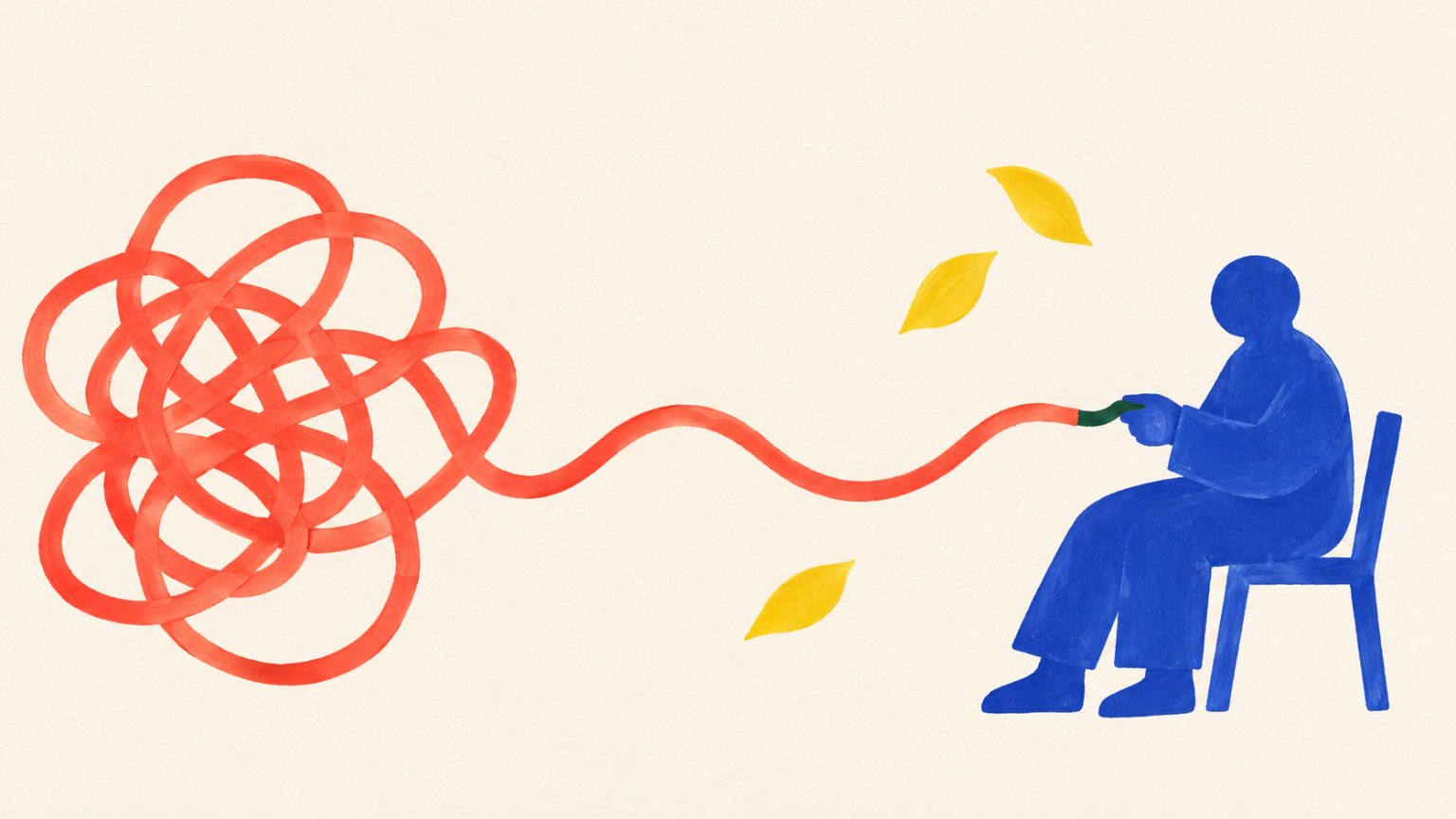
People who search for how to calm their nervous system usually have a concrete reason. The heart pounds although nothing has happened. The mind keeps running at three in the morning. After a hard day the body will not come down.
Often it shows up more quietly. You struggle to fall asleep or to sleep through. You forget more than usual or cannot recall things you know for certain. You are irritable in conversations and have less patience. Your digestion acts up, or your appetite goes. Our nervous system has many ways of speaking up when it is overloaded.
The good news: in moments like these there is usually nothing fundamentally wrong with your nervous system. It is doing its job, just at the wrong time and for too long. This article explains what happens in the body, why breathing is a lever, and what to make of the current hype around the vagus nerve.
What happens in the body under stress
The autonomic nervous system controls what runs without our involvement: pulse, breathing, digestion. Two branches matter here. The sympathetic branch gets us ready to act. The parasympathetic branch takes care of recovery and digestion. They do not work like a switch with two positions. They balance each other constantly.
When the brain rates a situation as threatening, Gert Kaluza describes the chain like this: the amygdala sounds the alarm and activates a stress centre in the brainstem, the locus coeruleus. From there the signal travels through the sympathetic nerves to the organs and adrenal glands, and within fractions of a second breathing, pulse and circulation rise. This makes sense. The body is preparing for fight or flight.
The trouble starts when the situation cannot be resolved. You can neither fight an email nor run away from one. So the activation stays on instead of fading once the work is done.
Calm your nervous system: why breathing is a lever
You cannot lower your pulse or blood pressure by deciding to. Your breathing you can. It is one of the few functions that runs on its own and can still be steered at any moment.
Two findings show what lies behind this. Stanford researchers found a small group of nerve cells in the breathing centre of mice that connect directly to the locus coeruleus. When these cells were switched off, the animals kept breathing normally but were clearly calmer. This is basic research in mice, but it shows a possible link between breath and arousal.
In humans it is established that slow breathing raises heart rate variability, the variation between two heartbeats. It is seen as a measure of how strongly the calming branch of the nervous system acts on the heart. A review of 223 studies confirms this during the exercise and afterwards.
The limits belong here too. In a study of 108 participants, five minutes of breathing a day improved mood, but everyday heart rate variability stayed the same. And what works for the mind is less clear than many guides claim. You will also find eight exercises with instructions there.
What to make of the vagus nerve hype
The vagus nerve is real and important. It connects the brain, heart, lungs and gut and is the main line of the parasympathetic system. Online it has become a cure-all: activate it, massage it, stimulate it.
Caution is in order. The popular language of a “regulated nervous system” comes largely from Stephen Porges’ polyvagal theory, which is disputed among experts. The psychophysiologist Paul Grossman considers its five basic premises hardly tenable, and Porges rejects this criticism. As an image, the theory can help people understand their reactions. It should not be sold as settled biology.
My view: I have no time for declaring every discomfort a nervous system disorder. Someone who is under pressure and sleeping badly often has no nervous system problem. They have a problem with too much work, a conflict, or a decision that is due.
What else can calm your nervous system
Exercise. A large overview pools more than 1,000 studies and finds medium effects on distress and low mood, including in healthy adults. The quality of many included reviews is low, however. Exercise still suits a body on alert, because that body wanted to do something anyway.
Switching off. The work psychologist Sabine Sonnentag shows that a heavy workload makes it harder to detach mentally, and that poor detachment goes along with lower wellbeing. The end of the working day needs a boundary that is more than closing the laptop.
A conversation. Practice shows that talking can help you work out what exactly is weighing on you. Often it is a mix of things that have become too much. Giving the feeling of strain a voice is often the important first step.
Looking at the cause. Ask yourself what is setting off the alarm. It is uncomfortable, but often the most effective point. See also Understanding Resilience.
Calm your nervous system in two minutes
Breathe in through your nose for four counts and out for six. Do this for two minutes. Then put your feet on the floor and name what is going on in one sentence. This will not calm everything. It gives you the pause in which a clear thought becomes possible again.
For the working day, I have expanded on this in Breathing Exercises for Stress.
When you need medical advice
Have palpitations, chest pressure, shortness of breath, persistent insomnia or exhaustion checked. Such symptoms can also have a physical cause. I offer counselling and coaching, not psychotherapy or diagnosis, and I say so openly when someone else is the right person to see.
Frequently asked questions
How can you calm your nervous system quickly?
The fastest route is the breath: breathe out longer than you breathe in, for two minutes. This noticeably lowers acute tension for many people, but it does not solve the cause.
What calms the nervous system in the long term?
Regular exercise, enough sleep, real breaks from work, and resolving what sets off the alarm. Single tricks do not replace this.
Can you activate the vagus nerve?
Slow breathing measurably increases the vagus nerve’s influence on the heart. Many further promises around massages or devices are not well supported.
What does an overstimulated nervous system mean?
It is not a medical term. People usually mean lasting tension: poor sleep, irritability, restlessness. If it persists, have it checked by a doctor.
Sources
- Kaluza G: Gelassen und sicher im Stress. Springer. Link
- Yackle K et al. (2017): Breathing control center neurons that promote arousal in mice. Science 355. Link
- Laborde S et al. (2022): Effects of voluntary slow breathing on heart rate and heart rate variability. Link
- Balban MY et al. (2023): Brief structured respiration practices enhance mood and reduce physiological arousal. Cell Reports Medicine. Link
- Grossman P (2023): Fundamental challenges and likely refutations of the five basic premises of the polyvagal theory. Link
- Singh B et al. (2023): Effectiveness of physical activity interventions for improving depression, anxiety and distress. British Journal of Sports Medicine. Link
- Sonnentag S et al. (2015): Recovery from job stress: the stressor-detachment model as an integrative framework. Journal of Organizational Behavior 36. Link
If your body will not come down, it is worth looking at what is keeping it up. That is what I work on in life coaching.