

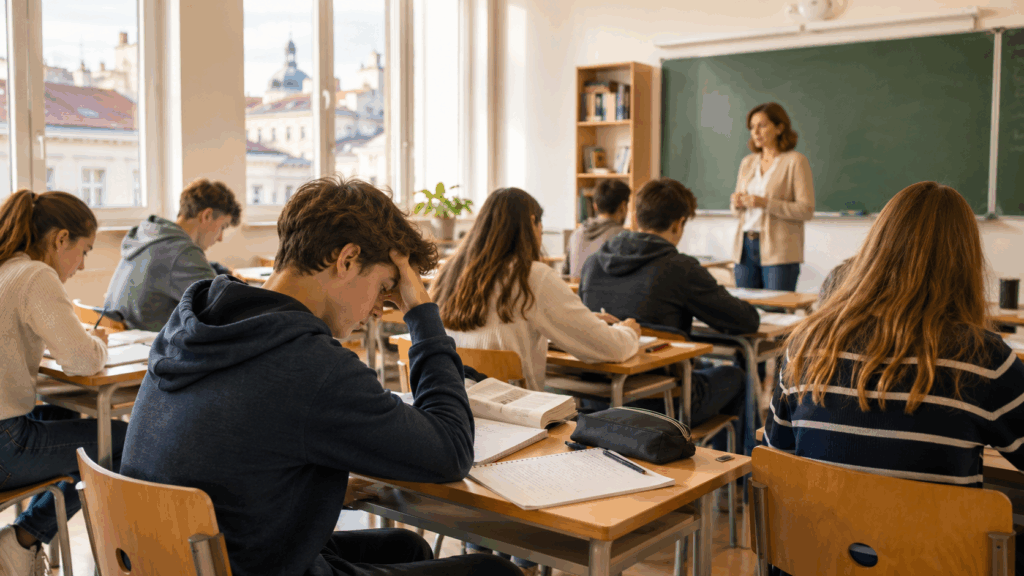
Student coaching in Vienna — typical topics from school life. Students today face enormous demands in modern school life. That’s not only due to developments within schools themselves, but also to the increasingly complex lives students lead. Today, more than ever, people are exposed to media and social influences. This can lead to difficulties in everyday school life. It often doesn’t affect students who are generally classified as “poor students” — instead, difficulties frequently arise in just one or two subjects. These can’t be satisfactorily fixed through tutoring alone, and they tend to widen further over the course of a student’s school career.
Topics that come up in student coaching are often:
- I’m generally good at school, it just doesn’t work out in math
- I can concentrate well at home, but I have a complete blackout during tests
- I can’t manage to study regularly
- I get distracted far too easily when doing homework
- I simply can’t remember certain vocabulary
- I just can’t motivate myself to do homework
What Coaching for Students in Vienna Actually Means
Student coaching in Vienna is not a substitute for tutoring, and it’s not a therapeutic offering. It’s a targeted process that picks up where tutoring stops working: at the inner patterns that block performance. A student who struggles in math despite mastering the fundamentals usually doesn’t have a knowledge problem. They have a problem with believing in their own ability, with their inner attitude toward the subject, or with how they handle pressure and expectations.
In Vienna, students also face a specific environment: a wide range of school options, high performance pressure in secondary schools, and a social environment shaped by digital media that’s present around the clock. These factors intensify concentration problems, procrastination, and test anxiety. Information on how the Austrian education system is structured and what’s expected of students is available at Bildung.gv.at (Austrian Ministry of Education).
Student coaching addresses exactly these points. It’s about working together to find out what’s behind a block, which beliefs are standing in the way, and what concrete changes in thinking and behavior could look like. The result isn’t just better academic performance, but a student who regains trust in themselves.
How NLP Methods Help With Learning Blocks
NLP, or Neuro-Linguistic Programming, works with the way people process information, regulate inner states, and respond to situations. NLP methods are especially effective for students who keep falling into the same traps, because they address the roots of blocks directly.
How learning fundamentally works in the brain, and why knowledge doesn’t automatically translate into new behavior, is explained in the article Understanding Learning: How Knowledge, Skills, and New Behaviours Develop.
A classic example: a student prepares well, then sits down for a test and has a complete blackout. That’s not a knowledge problem. It’s a state problem. The inner state during the exam differs significantly from the state while studying at home. NLP techniques help make resourceful states consciously accessible and available on demand in stressful situations.
Specific NLP methods used in student coaching include:
- Anchoring techniques: Positive learning states are anchored and can be consciously activated when needed, for example before a test.
- Reframing: Negative beliefs like “I’m just bad at math” are reassessed and turned into constructive perspectives.
- Submodalities: Students learn how to weaken uncomfortable imagery and strengthen motivating mental images.
- Strategy modeling: Successful learning strategies are made conscious and transferred to problem areas.
- Timeline work: Past experiences that shaped negative beliefs are resolved and reintegrated.
These methods are no magic bullet, but they’re powerful tools when applied professionally. As an NLP Master Practitioner, Tobias Judmaier combines these techniques with a clear coaching framework tailored to each student’s individual situation.
The Parent’s Perspective: When Does Coaching Make Sense?
Many parents reach a point where tutoring no longer brings improvement, homework leads to daily arguments, and the child seems increasingly frustrated or demotivated. That’s often the moment coaching enters the conversation. But when exactly does it really make sense?
Coaching makes sense when:
- Your child is genuinely competent in the subject but falls apart under exam pressure
- Motivation and self-organization don’t improve despite repeated conversations
- Your child describes themselves as “too dumb” for a particular subject
- Distraction and procrastination dominate everyday life
- School problems are starting to affect self-esteem
- The relationship between parent and child is suffering under academic pressure
Coaching is not a sign of weakness and not a last resort. It’s a proactive step that teaches your child to deal constructively with themselves and their challenges.
More on the methods used in coaching: Methods in Coaching | Life Coaching in Vienna
Frequently Asked Questions
How can you recognize learning blocks in students?
Typical signs include good performance in most subjects alongside pronounced difficulty in one specific subject, trouble concentrating despite a quiet study environment, blackouts during tests despite good preparation, and procrastination or test anxiety.
What can NLP methods achieve in coaching for students?
NLP techniques such as reframing, working with submodalities, strategy modeling, and timeline work address the root causes of blocks: they help transform negative beliefs, weaken uncomfortable imagery, and bring successful learning strategies into conscious awareness.
Is student coaching the same as tutoring?
No. Tutoring conveys subject knowledge, while coaching addresses the underlying blocks, beliefs, and inner state. That’s why it often works where pure knowledge transfer reaches its limits.
When should parents seek professional support?
When tutoring no longer brings improvement, distraction and procrastination dominate everyday life, school problems start affecting self-esteem, or the relationship between parents and child suffers under academic pressure.
